WHAT DO COURT REPORTERS ACTUALLY DO?
Court Reporter
noun- A person whose occupation is to make a word-for-word record of legal proceedings, such as trials, depositions, and hearings, typically using a stenotype machine, voice writing, or digital recording equipment. "The court reporter requested that the witness speak up so every detail could be accurately transcribed."
- An official responsible for capturing and transcribing spoken spoken words into an official legal transcript for court records.
Being a stenographic reporter, I, like most reporters, assume that everyone understands what it is we do. Unfortunately, over the decades, it becomes clearer and clearer that not even the people that we work with every day in the legal field have a clear understanding of it.
I know, I know, you probably think we show up, set up our little machine, write what you’re saying, pack up, leave, go home, type up your transcript on a word processor, and then charge too much!
Oh, contraire! Yes, we show up with our little machine, but it’s not just any little machine. That little machine costs thousands of dollars for a reason. While we’re writing what you’re saying, that little machine contains our dictionary of how we write the words you’re saying and is simultaneously translating into English words on its own screen. It’s time-stamping our strokes down to the nanosecond so there can be no doubt as to manipulation of the record we’re making. It’s audio-recording internally. It’s internally storing each of those strokes as well as storing to external drives for backup. Whether we’re blue-toothing or hardwired, it’s sending it to our laptop software.
And then there’s our software, which costs thousands of dollars, and is definitely not a word processor. Our software also has our dictionary of how we write not only the words that you’re saying, but special briefs we’ve added for YOUR particular job. It has hot keys for quick editing, margin formatting that needs to be set for the correct jurisdiction requirements, spell checking, indexing, the non-generative AI component, and now a generative component that the reporter may or may not utilize. The reporter defines who their speakers are and, wha-la, that’s how the reporter identifies the speaker simultaneously as you’re speaking.
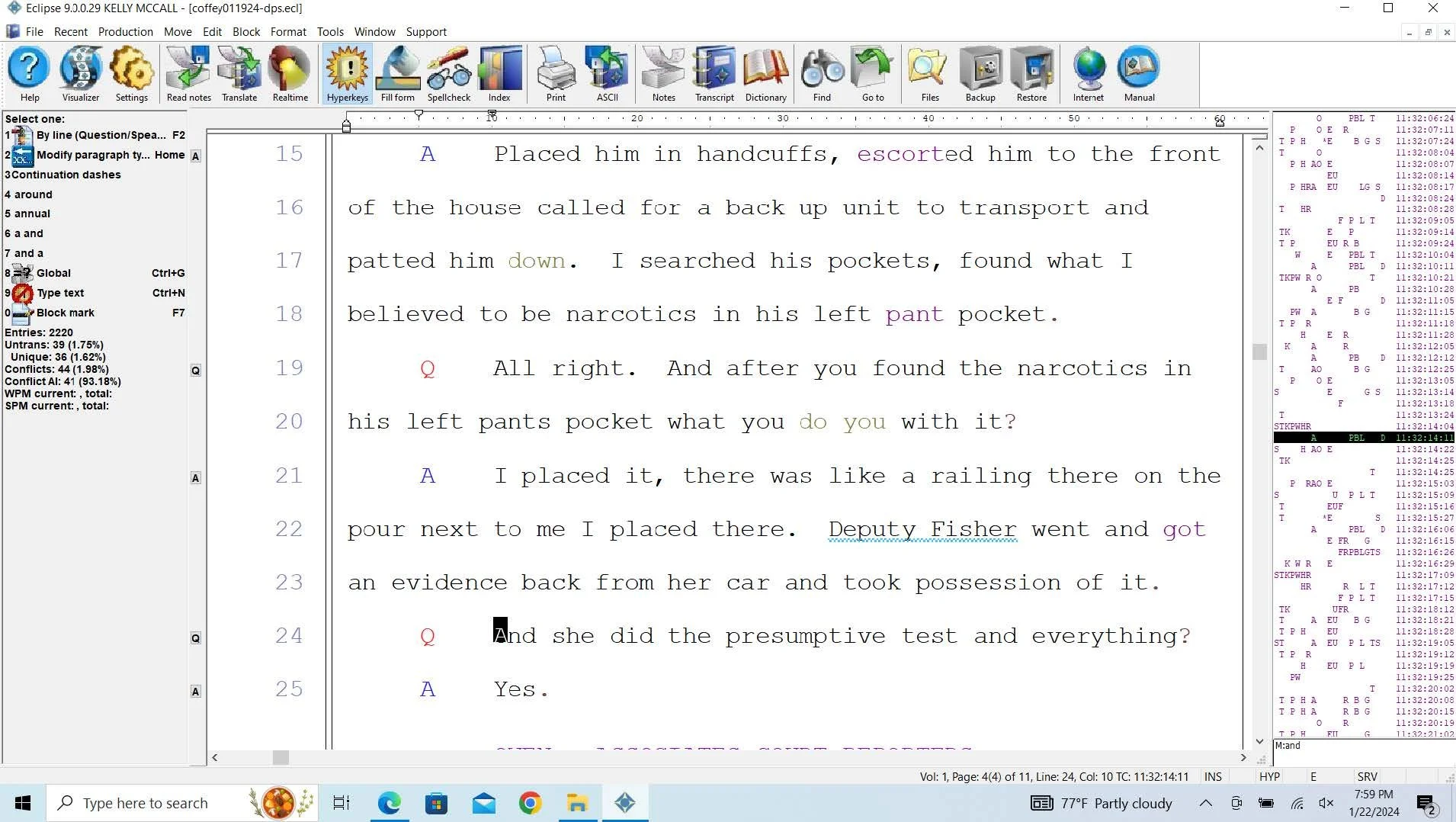
This software also has the audio-recording component, so that if you would rather hear live recording readback as opposed to the reporter reading back, the reporter finds where you want to start and hits the hot keys for playback.
Our software does many, many other processes, such as converting into compressed transcripts, pdf and other attorney software formats, word indexing, change screen appearances for CART writing, and sends our realtime screens to judges and attorneys as needed.
All of this is handled so that we can show up and write on our little machine. Then after the job, usually we’ll get any additional spellings, etc., and THEN we’ll pack up!
Of course, it’s not over then, although you’ll not see any of the rest of what we do, so here comes more interesting stuff. If you order a transcript right then, the reporter will go back over the realtime transcript that was being created as you were saying, adding the cover pages and certificates, etc. The reporter will then go through and check each word, the punctuation, the exhibits, the appropriate parentheticals.
The reporter might use what we call a scopist, in which case the rough transcript and notes will be sent to a person trained in the software and stenographic note-reading. That scopist will do the actual edit, and be paid for doing it, and send it back to the reporter to proof and certify. The reporter will then send out the transcript, but will have to still retain all of her notes and backups for two more YEARS after transcription.
What happens if you don’t order it at the time? The reporter is responsible for storing those notes and backups and exhibits for five YEARS, just in case you might want it. The reporter will have a system whereby they store to disk or pay for cloud service or both to ensure that the record stays safe.
What happens when you do order it four years and 364 days after the reporter took it down? The reporter pulls her notes and backup out and transcribes it. Of course, since our software is constantly being improved and updated, the reporter is responsible for keeping the software support up so that he or she can actually pull those notes up and transcribe it, in addition to any storage fees… and then retains those notes and backups for two more YEARS!
Why all of this retention even after transcription, you say? Because as a reporter, you are responsible for producing a complete and accurate verbatim record. Although the standards have lessened to “adequate” record in many cases, stenographic reporters do not ethically go by that lowered standard. Our Florida rules gives the parties two years to go back over that transcript to check it for material errors or any other problem that the reporter will need those notes and backup to check to see if he or she, in fact, made a material error (speaker misidentification, incorrect word that changes the meaning of the record). If the reporter made a material error, he or she will then necessarily have to file an affidavit or certificate of correction for that page and line.
So when you are paying for a court reporter, you’re not just paying for someone to come hang out with you. You’re not just paying for the amazing skills of “writing fast.” You’re paying for highly advanced equipment and software, the reporter who knows how to utilize it, a scopist if it’s needed, and years of storage and software support!
But why, when you can just digitally record it, run it through VR (voice recognition) and ChatGPT, and make your own transcript? That is fine if it’s just your work product for a summary, but even a third-grader can manipulate digital recordings. Even with all the mikes in the world, VR can simply not handle identification of people who have no mikes or people with certain accents or colloquial language. Of course, no non-public proceeding should be run through an AI program like ChatGPT because of the responsibility attorneys have to protect confidential information. But even on a “safe” AI system, AI is going to try to “fix” the content to what it has a history of. That’s just what AI does. You still have to have someone to authenticate the recording, check it word-for-word against the transcription, and be willing to sign off on it who is not an interested party.
Digital recordings are fine for low-transcript proceedings that will probably never require a transcript, but if you are planning on using a transcript for impeachment purposes, perjury purposes, in lieu of live testimony at trial or appellate purposes, a verbatim reporter’s certificate is the only self-authenticating certificate that is automatically recognized as self-authenticating. A transcriptionist’s certificate is certainly not the same thing because they do not go through all of the steps that verbatim reporters go through to ensure the “chain” of your record does not break, and, in most jurisdictions, their accuracy or adequacy has to be stipulated to by both counsel and/or the court.
Because of all of the things stenographic reporters do in addition to “writing” on our little machine, the Florida Supreme Court recognizes that we are the Gold Standard for guarding the record that you make…because it ain’t ovuh till it’s ovuh!